
Estimated reading time: 9 minutes
Key takeaways
- Slow feeding produces a coarser grind with fewer fines at identical settings.
- Fewer fines let water pass through an espresso puck faster.
- Reducing fines can improve clarity but may cost body and intensity.
- Repeatable feed rates matter more than the slowest possible feeding speed.
Specialty coffee professionals now control more of the grinding process than ever. Baristas spray beans with water, swap burrs to test different geometries, adjust motor speed, and single dose their coffee to manage exactly what enters the grinder and when.
As single dosing has spread, attention has moved to what happens to beans just before they reach the burrs. Slow feeding is one technique gaining ground. The barista starts the motor first, then introduces the beans gradually instead of dropping the full dose in at once.
The change sounds minor. However, testing suggests it can significantly alter how a grinder processes coffee. The technique has also reached the competition stage, with Australian competitor Simon Gautherin using it in his preparation for the 2026 World Brewers Cup, where he finished second.
As a result, feed rate is drawing attention as a variable with its own measurable effect on cup quality.
You may also like our article on how single-dose grinding is changing.

Why particle size matters
Grinding shapes extraction. Smaller particles expose more surface area to water and release more soluble material, while the spread of particle sizes affects how evenly water moves through a coffee bed.
For baristas and competitors chasing small gains in extraction and clarity, controlling particle size distribution has become a priority.
“My theme for the World Brewers Cup was clarity, so throughout my preparation I was looking at every single variable that could potentially help me achieve a cleaner, more precise cup,” says Simon Gautherin, the founder of Apax Lab. This led him to test how he fed the coffee into the grinder. He compared grinding a full dose normally against feeding beans in one at a time.
“In blind tastings, I was consistently choosing the slow-fed coffee. I found it cleaner, with more clarity, less dryness, and less bitterness,” he says.
The method is simple. Instead of the full dose sitting above the burrs or entering them all at once, slow feeding introduces a small quantity of beans at a time.
In 2019, Jonathan Gagné investigated the effect of grinding beans individually while studying “popcorning”, where beans bounce around inside a near-empty grinder because no weight of coffee above pushes them toward the burrs. His testing found that individually fed beans tended to grind coarser. Barista Hustle later explored how the balance between coffee entering and leaving the burrs could affect fines production.
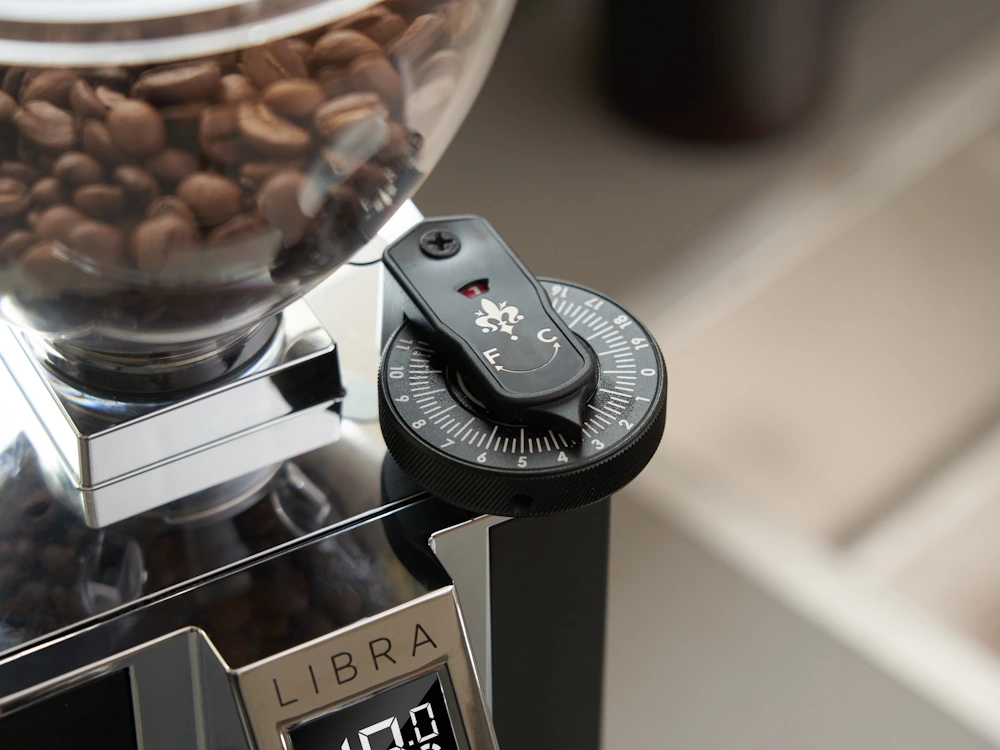
The science behind slow feeding
When the full dose enters the grinder at once, the grinding chamber becomes crowded. More beans interact with each other and with the burrs at the same time, and beans and fragments press and collide as they move through.
Nate Secinaro, founder of ARO Espresso, believes these interactions explain much of the difference. “What is actually changing is the interaction between the beans and the burrs, but probably more importantly, the interaction between the beans themselves while they’re being ground,” he says.
With heavily loaded burrs, coffee is more likely to contact both burr surfaces and other fragments before it leaves the chamber. Nate says this can cause extra fracturing, or “regrinding”. By contrast, feeding beans gradually leaves the chamber less crowded and puts less load on the motor and burrs.
Effect on particle size
Independent testing by Kaffeemacher found a measurable effect on particle size. At the same grind setting, slow feeding produced a coarser average grind and noticeably fewer fines across two coffees.
However, the results didn’t show a straightforward shift towards a more uniform grind. Kaffeemacher found that other parts of the particle size distribution could broaden slightly. When the team adjusted the grinder finer to restore the original espresso flow, the share of fines rose again.
Slow feeding, therefore, doesn’t always produce fewer fines. Instead, changing the feed rate can substantially alter how a grinder processes the same coffee at the same setting.
Nate has seen this in his own testing on a Eureka Mignon XL. Using a 100µm sieve, he found his slow-fed samples produced far less material below that threshold than traditionally ground samples. The difference became clearer still when he pulled espresso without changing the grind setting, as the slow-fed shots consistently ran much faster.
“Obviously shot time isn’t a direct particle size measurement, but when you combine that with the sieve results it gives a pretty clear picture,” Nate says. “At the same grinder setting, slow feeding is producing a grind that allows water to move through the puck much more easily.”
Published research helps explain why. A 2024 study by Samo Smrke, André Eiermann, and Chahan Yeretzian found that a higher share of fines reduces an espresso puck’s permeability, slowing flow and lengthening extraction time. The study didn’t examine slow feeding, but it shows why changes in fines production have such a clear effect on espresso flow.
Grinder design also plays a part. Rona Ramadani of Eureka says feed rate is one element of a larger system. “The way beans enter and interact with the burrs can affect how they are broken down and therefore the distribution of particle sizes,” she says. “It is one of several variables that can influence grinding performance, together with burr geometry, motor speed, alignment, and grind setting.”
Because these factors combine, slow feeding is unlikely to affect every grinder in the same way.
What changes in the cup
Results in the cup depend on what the barista wants to achieve. Simon found slow feeding most useful when chasing clarity in filter coffee, as less bitterness and dryness made individual flavours easier to identify. Nate has noticed a similar effect with espresso, especially lighter roasts, but says there can be a trade-off.
“If you really like that heavy, syrupy traditional espresso profile, reducing fines isn’t automatically going to make the coffee ‘better.’ It’s just a different profile,” Nate says.
Fines contribute to body, intensity, and flow rate, so reducing them will not automatically improve flavour. For some coffees, the extra clarity may suit the intended profile; for others, the loss of body could work against it.
Claims that slow feeding reduces static are less clear. “Static is harder because I haven’t directly measured electrical charge, so I don’t want to say I’ve proven slow feeding reduces static,” Nate says.
The available evidence more convincingly shows that feed rate can change particle distribution, grinder behaviour, and extraction. Whether those changes improve the cup depends on the grinder, the coffee, and the barista’s goals.
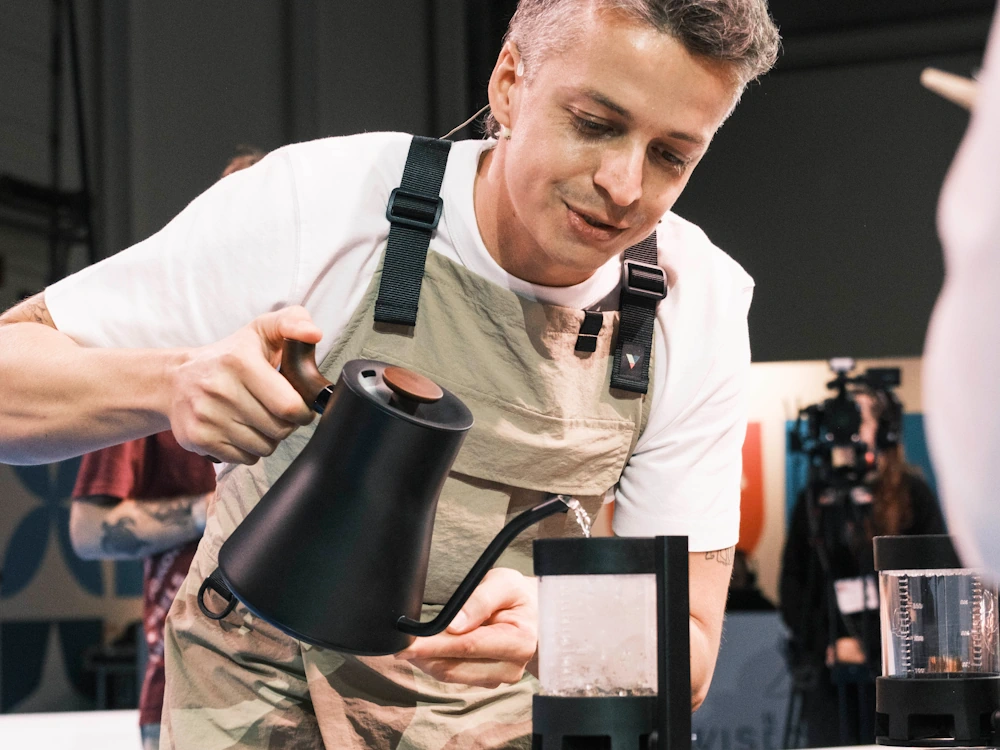
From competition stage to grinder design
Slow feeding creates a dilemma. If feed rate alters the grind, inconsistent hand-feeding adds another variable to control.
“If I’m competing and I genuinely believe something can make my cup even slightly cleaner, more repeatable or more expressive, I’m going to investigate it,” Simon says. “For competition, repeatability is everything. If a technique gives you a great cup once but introduces another unpredictable variable into your routine, I’m probably not going to use it.”
There is also a market for automated devices that retrofit onto existing grinders. For example, the ARO Slow Feeder and ARO Slow Feeder PRO meter beans into compatible grinders at an adjustable rate, while Simon used a CremaLoop device during his competition preparation.
Consistency and control remains central
Automation makes the technique easier, but its main advantage is repeatability.
“So for me, the bigger thing isn’t ‘as slow as possible.’ It’s being able to control the rate and repeat it consistently,” Nate says.
This point could prove more significant than slow feeding itself. Grinder manufacturers have long used augers, prebreakers, and other mechanisms to control how beans enter the burrs. Nate believes feed rate could become independently adjustable, in the same way some grinders now let users change RPM.
“We believe controlled bean feeding will become an increasingly interesting area of grinder development, particularly within the specialty coffee segment,” Rona says. “At the same time, we do not see slow feeding becoming essential for every grinder.
“Since controlled feeding is still a relatively niche area, we believe further testing and research are needed before drawing definitive conclusions about its benefits and how broadly it should be applied.”
Competition is likely to remain a key testing ground. Simon says more competitors are already experimenting with slow feeding, as small gains in clarity or repeatability can influence final scores. The same workflow may not suit a busy café bar or a home setup.
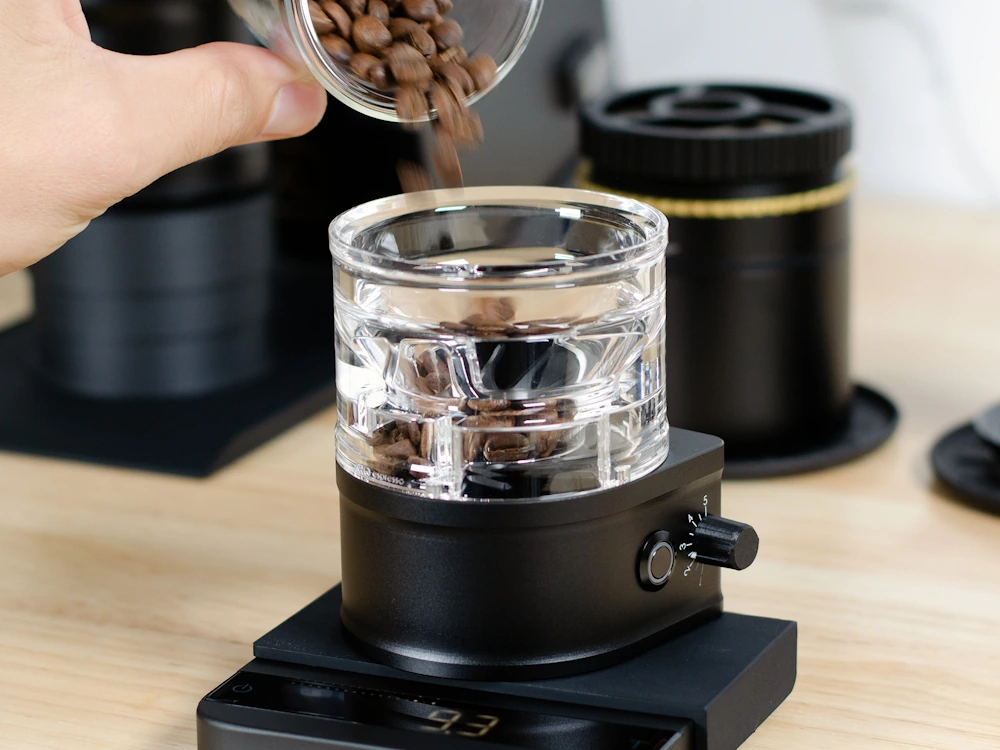
Feeding every coffee as slowly as possible is unlikely to be the answer. Instead, controlled feeding gives baristas another pre-grinding parameter to test alongside the Ross Droplet Technique (RDT), RPM, and burr geometry when dialling in a coffee.
“It’s not magic, and it’s not going to compensate for the wrong coffee, poor roasting or bad brewing,” Simon says. “It’s another tool. But at World Championship level, sometimes those small tools are exactly where the difference is made.”
For baristas and competitors who scrutinise every part of their grinding process, learning to control feed rate may prove more valuable than simply slowing it down.
Interested in making more sales? PDG Media specialises in growing sales for coffee businesses. Check them out here.
Slow feeding coffee grinding FAQS
What is slow feeding?
Slow feeding is when baristas start the grinder’s motor first, then gradually introducing beans instead of dropping the full dose at once. Baristas can feed beans by hand or use an automated device, such as an ARO or CremaLoop feeder, to control the rate.
Does slow feeding always reduce fines?
No. At the same grind setting, Kaffeemacher found slow feeding produced fewer fines. However, when the team adjusted the grinder finer to restore the original espresso flow, the share of fines rose again, and parts of the distribution became slightly broader.
Will slow feeding make my coffee taste better?
It depends on the coffee, the grinder, and the flavour profile you want. Competitors report cleaner, clearer cups with less bitterness, especially in filter coffee and lighter roasts. However, fewer fines can reduce body, so espresso may lose complexity and intensity.
Photo credits: Specialty Coffee Association, Eureka, Aro Espresso
Perfect Daily Grind
Want to read more articles like this? Sign up for our newsletter!